
Email Warm-Up: Why It Matters, When You Need It, and How to Do It Right
Author:
Sarah Ganote
Category:
Marketing
Email warm-up is one of those deliverability concepts that many marketers don’t think about until something breaks.
I’ve personally experienced it during major transitions, like when my former company rebranded and launched a new website domain, and another time when we kept the same email list and sender but migrated to a new marketing platform. From our perspective, nothing meaningful had changed. Same audience. Same content. Same sender.
But mailbox providers didn’t see it that way.
Suddenly, our email program looked like a brand-new sender. A new domain. New sending infrastructure. Different IPs. Different patterns.
To inbox providers like Gmail, Outlook, and Yahoo, that type of change can resemble something much less innocent: a spammer launching a new sending environment.
That’s where email warm-up comes in.
Email warm-up is the process of gradually building trust with mailbox providers by increasing sending volume slowly and generating strong engagement signals. When done correctly, it helps ensure your emails land in the inbox rather than the spam folder.
What Email Warm-Up Actually Does
Mailbox providers evaluate senders using behavioral signals. They don’t know your marketing plan or your internal systems. Instead, they analyze patterns such as:
- Sending volume
- Sender reputation
- Engagement rates
- Complaint rates
- Domain and IP history
When those signals suddenly change, it raises suspicion.
Email warm-up acts as a trust-building process. By gradually increasing email volume and maintaining strong engagement metrics, you demonstrate to mailbox providers that your sending behavior is legitimate and consistent.
When Email Warm-Up Is Necessary
Warm-up becomes important whenever mailbox providers perceive a major change in sending behavior or infrastructure.
Switching Email Platforms
One of the most common triggers is switching email service providers.
For example, migrating from Salesforce Marketing Cloud to HubSpot changes the infrastructure behind your email program. Even if the list stays the same, mailbox providers suddenly see:
- New sending IP addresses
- Different authentication signals
- Changes in sending patterns
Without a proper warm-up process, these changes can trigger filtering or throttling.
Rebranding or Changing Domains
Launching a new domain during a rebrand essentially means starting with no sender reputation.
Inbox providers have no history of engagement for that domain, which makes them cautious about trusting the emails it sends.
Warm-up allows the new domain to build credibility gradually.
Infrastructure Changes
Other technical changes can also trigger warm-up needs:
- Moving to new IP addresses
- Launching a new sending subdomain
- Switching email infrastructure
- Dramatically increasing sending volume
From the mailbox provider’s perspective, these changes can resemble suspicious behavior if they happen too quickly.
Recovering from Deliverability Problems
Sometimes warm-up isn’t about building trust; it’s about rebuilding it.
Organizations experiencing deliverability issues often see symptoms like:
- High bounce rates
- Spam complaints
- Sudden drops in inbox placement
- Blacklisting
A structured warm-up helps stabilize engagement signals and repair sender reputation.
Why Mailbox Providers Are So Cautious
Spam prevention is the main reason email warm-up exists.
Spammers frequently use a tactic known as “burn and turn.” They send large volumes from a new domain until it gets blocked, then abandon that domain and start again with another.
Because of this behavior, mailbox providers treat new senders with skepticism.
Unfortunately, legitimate businesses switching platforms or launching new domains can appear similar to these patterns.
Without a warm-up, your email traffic may look like spam — even if it isn’t.
The Hidden Risk of Skipping Warm-Up
Skipping warm-up doesn’t remove the cost.
It simply delays it.
Mailbox providers may respond to sudden sending changes with:
- Throttling (limiting sending speed)
- Temporary sending blocks
- Spam folder placement
- Reduced inbox visibility
Over time, this can create long-term sender reputation damage.
The consequences often include:
- Lost marketing and sales revenue
- Brand credibility damage
- Longer recovery cycles
- Increased scrutiny from mailbox providers
Rebuilding sender reputation after it drops is far more difficult than protecting it from the start.
Why Data Quality Matters Before Warm-Up
Warm-up doesn’t begin with sending an email.
It begins with data discipline.
Before increasing sending volume, you must reduce risk within your list. Poor-quality data is one of the biggest threats to deliverability.
According to ZeroBounce research analyzing billions of addresses, email lists naturally decay by roughly 22–28% every year due to job changes, typos, abandoned inboxes, and disposable email addresses.
This means that if a list hasn’t been cleaned recently, a significant portion may already be invalid or risky.
Before warm-up begins, remove contacts that harm your reputation:
- Invalid email addresses
- Spam traps
- Abuse complaints
- Catch-all domains
- Old inactive contacts
Keep the contacts that strengthen engagement signals:
- Verified addresses
- Real subscribers
- Recent openers and clickers
Starting warm-up with the healthiest portion of your list gives mailbox providers the strongest possible engagement signals.
Benchmark Your Current Deliverability
Before ramping up sending volume, it’s important to measure where you stand.
This includes reviewing:
- Sender reputation monitoring
- Blacklist status
- Current open and click rates
- Inbox placement testing
These benchmarks reveal how mailbox providers currently perceive your domain and highlight any hidden risks.
Warm-up works best when it begins with a clear understanding of your baseline performance.
Start With Your Most Engaged Subscribers
Warm-up is not about emailing your entire list.
It’s about sending to the right people first.
Your earliest sends should target:
- Recent openers
- Recent clickers
- Highly engaged subscribers
Avoid sending to:
- Cold contacts
- Unengaged segments
- Long-inactive addresses
Strong engagement signals tell mailbox providers that recipients actually want your emails.
Increase Volume Gradually
One of the biggest red flags in email deliverability is a sudden spike in sending volume.
Mailbox providers monitor behavior patterns over time, and large jumps in email activity can look suspicious.
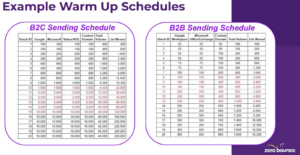
Warm-up relies on controlled growth, where sending volume increases steadily while engagement remains strong.
Email Warm-Up Example Schedule
Monitor Performance During Warm-Up
Warm-up is not an autopilot process.
After every send, performance metrics should be reviewed carefully, including:
- Engagement rates
- Bounce rates
- Spam complaints
- Inbox placement
If warning signs appear, sending volume should be adjusted.
Ignoring these signals can quickly undo the progress warm-up is designed to create.
How Long Email Warm-Up Takes
A typical warm-up process lasts 30 to 45 days, though the exact timeline depends on several factors:
- List size
- Sending volume
- Domain and IP history
- Industry sensitivity
Rushing the process increases the risk of spam filtering and reputation damage.
Patience is essential to building stable deliverability.
Common Email Warm-Up Mistakes
Even experienced marketing teams can undermine warm-up by making avoidable mistakes.
The most common include:
- Using unverified email lists
- Scaling sending volume too quickly
- Ignoring drops in engagement metrics
- Stopping the warm-up too early
Successful warm-up requires consistent monitoring and disciplined sending behavior.
Final Thoughts
Email warm-up is often misunderstood as a technical deliverability tactic. In reality, it is a trust-building process between your organization and mailbox providers.
Inbox algorithms rely on behavioral signals to determine whether a sender is legitimate. Warm-up allows your email program to demonstrate consistent engagement before scaling to full sending volume.
Skipping the process may seem faster, but the consequences often appear later through spam placement, reputation damage, and lost revenue.
A disciplined warm-up strategy protects one of your most valuable marketing channels and ensures your emails reach the inbox where they belong.
Concerned about your email deliverability?
If you’re switching platforms, launching a new domain, or seeing drops in engagement, our team can help you assess sender reputation, clean your data, and build a safe warm-up strategy. Talk to an Email Expert.

Sarah Ganote
HubSpot Specialist & Key Account Manager, Holland Adhaus
Empowering businesses with HubSpot expertise, email strategy, and marketing operations that turn data into growth.