
When Is It Time to Hire a Marketing Agency? Start by Looking for Random Acts of Marketing
Category:
Author:
Most businesses don’t wake up one day and suddenly realize they need a marketing agency.
It usually happens slowly.
A campaign does not perform the way you hoped. A social media page gets quiet. A few ads run without clear results. Someone internally takes on marketing “for now,” but that person already has a full-time job. Leadership wants growth, but no one has a clear view of what is working, what is not, or where the next best opportunity really is.
That is often the point when marketing starts to feel less like a strategy and more like a series of disconnected tasks.
At Holland Adhaus, we call those random acts of marketing.
In the video below, Allie Schroeder, Account Marketing Director at Holland Adhaus, shares when businesses should consider working with an agency, what an agency actually does beyond ads and content, and why strategy should come before tactics.
“Why Work With a Marketing Agency?”
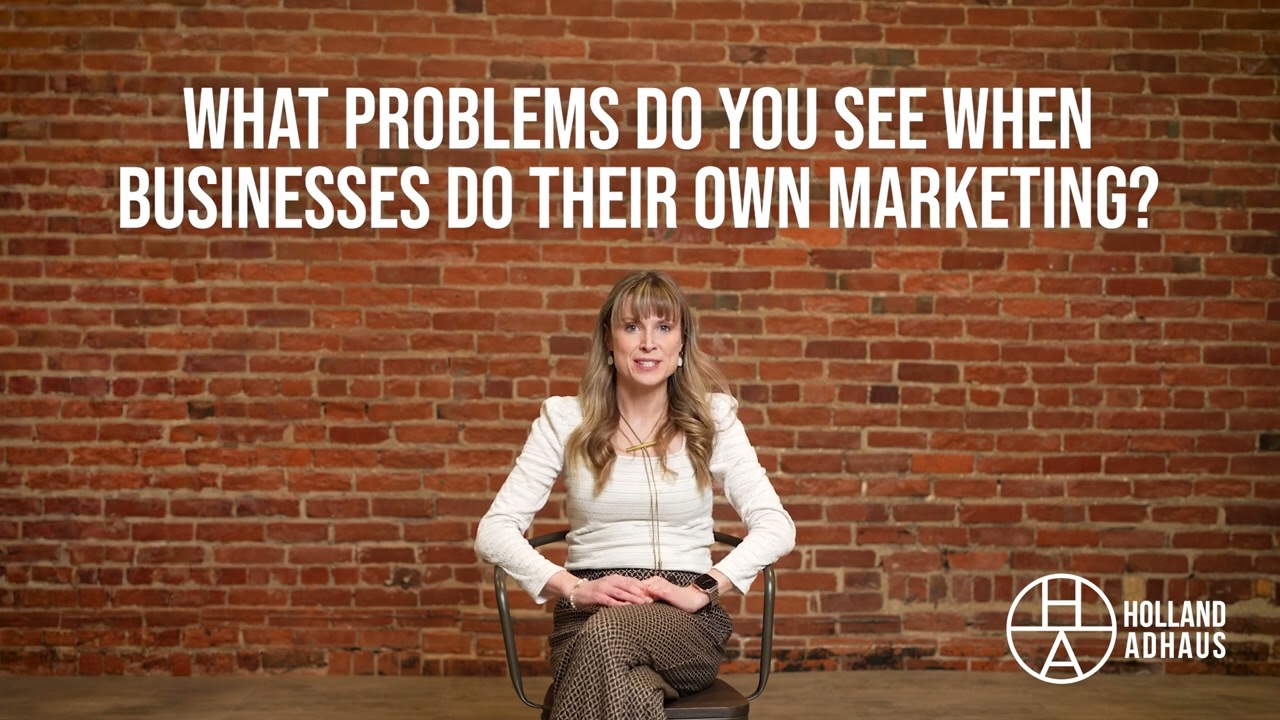
When Is It Time to Hire a Marketing Agency?
It may be time to hire a marketing agency when your growth has plateaued, your marketing feels inconsistent, your team lacks clear reporting, or your internal team does not have the time or specialized expertise to manage strategy, creative, media, analytics, and execution.
A lot of business leaders are excellent at running their business. They know their customers, their team, their services, their operations, and their industry.
But that does not mean they should also be responsible for building the website, writing the social captions, managing ad performance, interpreting analytics, creating customer personas, refreshing the brand, setting up tracking pixels, and deciding whether the latest marketing trend is actually worth pursuing.
Marketing is its own discipline. It changes constantly. Platforms evolve. Algorithms shift. Customer expectations change. New tools appear. Reporting gets more complex. And the businesses that grow intentionally are usually the ones that stop treating marketing like an afterthought.
What Are Random Acts of Marketing?
Random acts of marketing happen when a business tries disconnected tactics without a clear strategy, measurable goals, audience understanding, or consistent follow-through.
It might look like this:
- Running ads for one month and stopping because “they didn’t work.”
- Posting on social media only when someone remembers.
- Launching a campaign without tracking conversions.
- Trying to speak to every audience at once.
- Sending an email without a clear next step.
- Redesigning a website without understanding the buyer journey.
- Investing in tactics before defining the message.
The problem is not always the tactic itself.
The problem is that the tactic is not connected to a larger strategy.
Good marketing should not feel random. It should have a purpose, a goal, a target audience, a message, a measurement plan, and enough consistency to actually learn from the results.
Why Does DIY Marketing Stop Working as Businesses Grow?
DIY marketing often works in the early stages of a business because the needs are simpler. A founder, office manager, salesperson, or internal team member may be able to handle the basics for a while.
But as a business grows, marketing usually gets more complicated.
- You need clearer positioning.
- You need better reporting.
- You need stronger creative.
- You need a more strategic website.
- You need consistent content.
- You need sales and marketing alignment.
- You need someone watching performance.
- You need someone asking whether the money you are spending is actually moving the business forward.
That is when “we’ll just handle it internally” can start holding the business back.
Not because the internal team is not capable. Often, they are very capable. But they may not have the time, tools, or range of expertise needed to manage every part of a modern marketing strategy.
What Does a Marketing Agency Actually Do?
A marketing agency does more than create ads, graphics, videos, or social media posts.
Those deliverables matter, but they are only part of the work.
A strong agency helps businesses understand the bigger picture. That can include market research, competitor analysis, customer personas, brand strategy, campaign planning, website strategy, digital advertising, media buying, CRM support, analytics, reporting, content creation, video production, and ongoing optimization.
At Holland Adhaus, we look at marketing as part of the business growth system.
That means asking questions like:
- Who are we trying to reach?
- What do they care about?
- What problem are we solving for them?
- Where are they spending their time?
- What message will resonate?
- What does the sales process look like?
- How are leads being tracked?
- What does the data tell us?
- What should we do more of, less of, or differently?
The goal is not just to make marketing look good. The goal is to make marketing work harder.
Why Should Strategy Come Before Tactics?
Marketing strategy matters because it defines who you are trying to reach, what they need to hear, where to reach them, and how success will be measured before time and money are spent on tactics.
Without strategy, businesses often jump straight to execution. They want a new landing page, email, or campaign.
But before deciding what to create, it is important to understand why it needs to exist.
- Who is it for?
- What action should they take?
- What pain point are we addressing?
- How will this support the larger business goal?
- How will we know if it worked?
Strategy gives marketing direction. It helps prevent wasted effort, inconsistent messaging, and campaigns that look nice but do not move the needle.
Why Knowing Your Customer Is Still the Number One Rule
One of the most important rules in marketing is simple: know your customer.
Before you can write the right message, choose the right channel, or build the right campaign, you need to understand who you are trying to reach.
That means going beyond basic demographics.
- What do they care about?
- What problems are they trying to solve?
- What keeps them from taking action?
- What motivates them?
- What questions do they ask before making a decision?
- What would make them trust you?
This is why customer personas are still valuable when they are done thoughtfully. They help businesses stop trying to speak to everyone and start speaking more clearly to the people they actually want to reach.
When your audience is too broad, your message gets watered down. When your audience is clear, your marketing becomes more focused, more relevant, and more effective.
Should You Hire a Marketing Agency or an In-House Marketer?
An in-house marketer can be a great asset, especially for businesses that need daily internal support and brand familiarity. But one person usually cannot cover every specialized area of marketing at a high level.
A modern marketing program may require:
- Brand strategy
- Copywriting
- Graphic design
- Website development
- SEO
- AEO
- Paid search
- Paid social
- Traditional media
- Video production
- Photography
- CRM management
- Email marketing
- Analytics
- Reporting
- Campaign strategy
- Media negotiation
Finding all of that in one person is rare.
When you work with an agency, you get access to a team with different areas of expertise. Instead of asking one internal marketer to be the strategist, designer, writer, media buyer, data analyst, developer, and videographer, you can bring in specialists who know how to work together.
For many businesses, the best solution is not always agency versus in-house. It may be an agency supporting the internal team, filling gaps, adding strategy, and helping execute work that would otherwise sit on the back burner.
What Is the 60/40 Rule in Marketing?
The 60/40 rule in marketing is a principle that suggests businesses should invest roughly 60% of their marketing budget in long-term brand building and 40% in short-term lead generation or sales activation.
The exact split may vary by business, but the idea is important.
If all of your marketing is focused on immediate leads, you may miss the opportunity to build awareness, trust, and recognition over time. If all of your marketing is brand awareness with no conversion strategy, you may struggle to connect your efforts to revenue.
Strong marketing needs both.
Brand-building helps people know who you are before they are ready to buy. Lead-generation tactics help capture demand when they are ready to take action.
A good marketing strategy balances the two.
Why Repetition Matters in Marketing
Customers rarely take action after seeing one message one time.
They need repeated exposure to your brand before they recognize it, trust it, and feel ready to engage. That is why consistency matters across channels.
Your website, ads, emails, social media, print materials, sales collateral, and customer experience should all feel connected.
When your message is consistent, your brand becomes easier to remember. When your marketing is scattered, your audience has to work harder to understand who you are and why they should care.
The goal is not to say the exact same thing everywhere. The goal is to create a clear, recognizable brand presence that builds familiarity over time.
The Bottom Line
If your business is growing, but your marketing feels scattered, inconsistent, or difficult to measure, it may be time to bring in an agency.
Not because you need more random tactics.
Because you need a smarter strategy behind them.
A strong marketing agency helps connect the dots between your business goals, your audience, your message, your tools, your campaigns, and your results.
At Holland Adhaus, we help businesses move from reactive marketing to strategic growth. We bring together creative, digital, traditional, technical, and strategic expertise so your marketing is not just getting done. It is working with purpose.
Because growth does not come from doing more for the sake of doing more.
It comes from doing the right things, for the right people, with the right strategy behind them.
Ready to stop guessing at marketing?
If your team is tired of random acts of marketing, Holland Adhaus can help you build a clearer, more strategic path forward. Let’s talk about where your marketing stands today and where it could go next.
Frequently Asked Questions About Hiring a Marketing Agency
Q: When should a business hire a marketing agency?
A: A business should consider hiring a marketing agency when growth has plateaued, marketing feels inconsistent, internal teams are stretched thin, reporting is unclear, or the company needs specialized support across strategy, creative, digital advertising, web, content, and analytics.
Q: What does a marketing agency do?
A: A marketing agency helps businesses plan, create, execute, and measure marketing strategies. This can include branding, website development, SEO, AEO, paid advertising, social media, content, video, email marketing, CRM support, media buying, and reporting.
Q: What are random acts of marketing?
A: Random acts of marketing are disconnected marketing efforts that happen without a clear strategy, goal, audience, message, or measurement plan. They often lead to inconsistent results because the tactics are not connected to a larger growth strategy.
Q: Is it better to hire a marketing agency or an in-house marketer?
A: It depends on the business. An in-house marketer can provide dedicated internal support, while an agency provides access to a larger team of specialists. Many businesses benefit from using both, with an agency supporting strategy, execution, and specialized expertise.
Q: Why is marketing strategy important?
A: Marketing strategy is important because it defines who you are trying to reach, what message will resonate, where to reach your audience, what action you want them to take, and how success will be measured.
Q: How can a marketing agency help a growing business?
A: A marketing agency can help a growing business clarify its message, improve visibility, strengthen lead generation, align sales and marketing, build better campaigns, analyze performance, and create a more consistent brand presence. Learn more: https://www.youtube.com/watch?v=kgqrEh6dwaI
Ready to rethink your social strategy?
Let’s build a strategy that helps you show up with more consistency, creativity, and purpose.