
The Revenue Shield: Why SEO and AEO Are the "And" Solution for Modern Growth
Category:
AEO
There is a misconception circulating in the industry: that AEO is here to replace SEO.
It is not. And the distinction matters more than most businesses realize.
It is true that we have moved away from a web built solely on traditional, link-based discovery to one driven by AI-presented summaries and Large Language Models. Either you are seen in that environment—or you are not. And it may also be true that no one is more clear-eyed about what that means for your revenue than the strategists asking the harder question: not “what is AEO?” but “what does AEO protect?”
To help clarify this shift, I recently recorded a breakdown of why this evolution is critical for any business looking to stay visible where their customers are actually searching.
“The Revenue Shield: How AEO Makes You the Chosen Provider”
The "And" Solution: SEO as the Foundation, AEO as the Powerhouse
As I discuss in the video, AEO is not an “either-or” scenario. It is an “and” solution.
Think of your website’s architecture like a building. SEO—search engine optimization—is your foundation. Without it, you have no structure, no crawlability, and no authority. Nothing can be built on ground that does not exist. AEO, however, is the building blocks you place on top of that foundation. It is the strategy of becoming the chosen expert—the recommended provider that an AI surfaces when a user asks a complex question and needs an answer before they ever scroll to a link.
AEO is not here to replace SEO. AEO is an evolution of SEO. The technical foundation remains the same. Content remains king. But the way we show up, and the way people search, has shifted. AEO allows us to shift with it.
The goal is singular regardless of how you umbrella it—whether you call it AEO, GEO, or any of the other acronyms emerging in this space: be the chosen expert. That is what protects your revenue and keeps you in front of the people who are already looking for you.
Translating AEO Theory into Google Analytics Data
While the theory of “becoming the chosen answer” is compelling, the true value of AEO is found in the data. Recently, I conducted a performance audit for a partner in the medical sector to see if this shift to AI-driven search is actually impacting bottom-line results—or if it is still just noise.
The data confirms the shift is happening now.
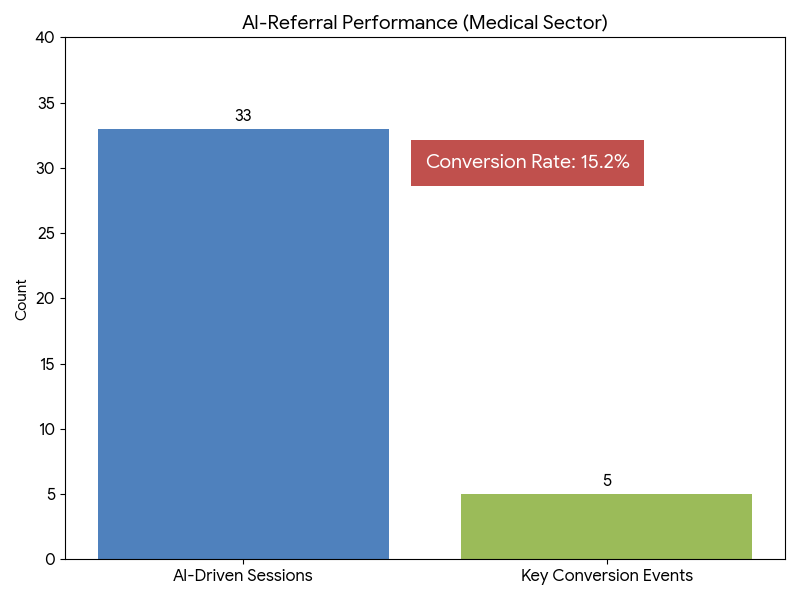
Across the audit period, we tracked 13,017 total organic sessions—Google leading as the dominant channel by a significant margin, followed by Bing, Yahoo, and DuckDuckGo. Within that data, we identified 33 sessions originating directly from AI-referral sources: ChatGPT, Copilot, and Perplexity.
Thirty-three sessions sounds modest. Here is why it is not.
Those 33 sessions generated 5 key conversion events. Thata a 15.5% conversion rate.
For a clinic, five patients—or prospective patients—who arrived via an AI platform and took a defined action- no ad budget involved.
That is not browsing behavior. That is bottom-of-funnel, high-intent behavior from users who were already pre-qualified before they ever landed on the site. The AI did the vetting. The site just had to close it
The "Leaky Bucket" and What the Data Is Actually Telling You
One of the most revealing findings from our audit was not just that the leaky bucket pages existed — it was why the conversion gap between organic and AI traffic was so stark.
This is where most people misread the data.
If your pages are ranking but not converting, that is a CRO problem — a conversion rate optimization problem. The fix lives in your page design, your CTAs, your user journey. That is not AEO’s job.
What AEO does is fundamentally different, and the audit data proves it.
Think of traditional SEO like a fisherman casting a net. You optimize for the right keywords, you cast wide, and you pull in everyone who matches. High volume. Mixed intent. Some buyers, some browsers, some people who clicked the wrong thing entirely.
AEO is a spear. Deep sea, targeted, precise. When a user constructs a prompt in ChatGPT or Copilot and the AI surfaces your brand as the answer, that user has already been matched to you with a level of specificity a keyword cannot replicate. The AI has read their intent, processed their context, and made a recommendation. By the time they land on your page, the vetting is done.
That is what explains the numbers. Thirty-three AI sessions. Five conversions. Not because the page worked harder — but because the lead arrived already qualified.
High volume, lower conversion rate: SEO.
Lower volume, higher conversion rate: AEO.
Same site, same pages, entirely different quality of traffic. The difference is not what happens after they arrive. The difference is everything that happened before.
The Pages Worth Prioritizing
The audit also surfaced a clear strategic picture of where to focus optimization effort.
Users arriving via organic search and landing on a specific physician’s page or a specific procedure page were far more likely to convert than those landing on general service overviews. This tells us that specificity is a conversion driver. The more precisely a page answers a user’s exact question, the more likely that user takes action.
For AEO specifically, the pages already receiving AI referral traffic are the highest-priority targets for entity optimization. These are the pages an AI is already surfacing. Ensuring they have complete schema, direct answers to common patient questions, and clear evidence of provider authority keeps them in that position and strengthens it.
Is AEO Worth It?
Here is the question I am asked most often—and my answer is the same every time.
AEO is your revenue shield.
When you are the chosen answer, you are not fighting for a click alongside ten other competitors. You are being presented as the expert recommendation. Your sales team is not walking into a cold conversation—they are following up with someone who has already been introduced to your brand by the AI. The trust is established before the call starts.
In business, AEO means showing up before your competitors. It means being the thought leader and the expert. It means taking the revenue share and being the market leader in your space—not because you outspent anyone, but because you became the source the AI trusts to answer the question.
Commonly Asked Questions About AEO
Q: What is AEO and how does it differ from traditional SEO?
A: AEO stands for Answer Engine Optimization. While SEO is the vital foundation of your search presence, AEO is the building block that turns that foundation into a powerhouse. It focuses on shifting from traditional link-based discovery to being the “chosen answer” surfaced by AI summaries and LLMs. You cannot build AEO without the technical foundation of SEO, but you need both to stay visible as the recommended provider. You can learn more about this strategic shift here: https://www.youtube.com/watch?v=_SnGXwrXegQ
Q: Is AEO replacing SEO, or is it just a buzzword?
Q: Is AEO replacing SEO, or is it just a buzzword? A: AEO is not here to replace SEO; it is an evolution of it. The technical fundamentals—crawlability, site structure, and high-quality content—remain the priority. However, the way users search has shifted, and AEO allows us to adapt to that new reality. To see how we are evolving search for modern growth, watch this breakdown: https://www.youtube.com/watch?v=_SnGXwrXegQ
Q: Does AI-driven traffic (ChatGPT/Copilot) actually convert, or is it just curiosity
A: AI traffic is high-intent, not just noise. Recent performance audits show that while AI-referral volume is smaller than traditional organic search, it converts at a significantly higher rate (our internal data shows a 15.2% conversion rate on AI-referred sessions). These are pre-qualified leads interacting with a brand presented as an expert. For more on the impact of AEO on sales, watch this: https://www.youtube.com/watch?v=_SnGXwrXegQ
Q: I have high traffic on my site, but low conversions—what’s the problem
A: This is often a “leaky bucket” issue. You are successfully attracting traffic (SEO is working), but the pages lack a clear “bridge” to conversion (CRO is missing). To optimize this, focus on entity-based content that directly answers user questions and implement low-friction Calls to Action (CTAs).
Q: How do I get started with an AEO strategy
A: Start by auditing your high-traffic pages to ensure they are structured to be the “chosen answer.” This means utilizing FAQ schema, ensuring your service information is definitively clear for AI models, and positioning your brand as the industry authority. You can see how we define that expertise by booking a free AEO audit- Answer Engine Optimization AEO
Q: Is AEO worth the investment for my business?
A: Think of AEO as your “revenue shield.” When you are the visible, recommended expert in the AI framework, your revenue is protected because you are the first—and often the only—provider a potential client considers. If your goal is to stay a market leader, the investment is not just worth it; it is essential. See why we believe this is the future of business growth: https://www.youtube.com/watch?v=_SnGXwrXegQ
Ready to see how AEO is impacting your business?
Sign up for a free AEO Audit and lets explore how you can transform interest into a high performing revenue channel